
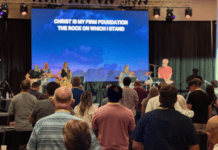











Ask most people how a church is doing, and the first thing they’ll want to know is how many people show up on Sunday.
But leaders who have wrestled seriously with the question of growth will tell you that a full parking lot is one of the least reliable measures of a healthy church.
Attendance matters, of course.
Rod Suess, lead pastor of Vinewood Community Church in Lodi, California, explains that in the church, growth is desirable and good but can easily become misleading.
“In general, God created things to grow, and healthy things grow,” Suess says. “But I think in the American church model, we equated growth with bigger, and they’re not quite the same thing.”
For Brent Warkentin, lead pastor at Ridgepoint Church in Wichita, Kansas, reaching as many people as possible with the gospel aligns with God’s heart to save his creation.
“Jesus didn’t go to all that work to reach fewer,” he says.
But for churches, Warkentin is equally clear that growth means more than bodies in pews.
“I think every church wants to grow in three ways: numerical, engagement and spiritual transformation,” he says.
Those three layers offer a far more complete picture of what it means for a church to truly grow—and for leaders and members of U.S. Mennonite Brethren congregations of any size, understanding the difference matters.
The first layer: numerical growth
Attendance is the most visible and easily tracked metric. What’s not easy is figuring out how to pinpoint where the growth is coming from.
Ridgepoint Church, which rebranded from First Mennonite Brethren Church in 2021 as part of a strategic push to reach the next generation, has seen significant numerical growth in recent years, with multiple services and in-person attendance averaging over 1,000 on Sundays.
Andy Owen, executive pastor at Ridgepoint, points to a combination of factors to explain this growth, including a building campaign to improve the physical space, changes at other local churches and what he describes as a move of God stirring across the country.
Despite Ridgepoint’s increased headcount, Owen cautioned against letting attendance become the only scoreboard.
“You can’t just measure your attendance and expect (the church) to grow,” he says.
At Vinewood, Suess says the church hovered between 200 to 300 attendees for years until the COVID-19 pandemic hit. At that point, attendance dropped to 100 or fewer at times.
Once normal services restarted, Suess says it felt as though the church had to rebuild itself: “It was like this is a different congregation.”
For Community Bible Church in Mountain Lake, Minnesota, numerical growth looks very different. Lead pastor Alex Janzen serves a congregation of about 25 people in a town of 2,000—a community where overall church attendance has declined significantly in the past few decades.
Janzen is candid about where things stand.
“We are gaining (new people),” he says, “but we’re losing people faster.”
It’s a reality many congregations know well. Yet Janzen and others refuse to let raw attendance numbers define what churches are doing.
“People in pews is not a guarantee that we are fulfilling the great commission,” Janzen says.
The second layer: engagement growth
Instead of focusing purely on the numbers, these pastors encourage churches to look at engagement as a better sign of healthy growth. However, it’s much harder to measure than attendance.
“How do you distinguish between someone who volunteers once a year and someone who is an every-week small group leader?” Warkentin asks. “Those are two very different levels of engagement.”
The complexity doesn’t mean churches should stop tracking how many are getting involved, but they should be thoughtful about what they’re actually measuring.
For smaller congregations, engagement can be a distinct advantage. One benefit of small churches is meaningful relationships form almost automatically.
“It doesn’t take nearly as much intentionality to build genuine relationships,” Janzen says. “If you show up to a small church consistently, you will make friends and have the opportunity to love your neighbor.”
The third layer: spiritual growth
The deepest and most important kind of growth is also the one that resists any spreadsheet. Warkentin calls it the place where transformation happens: marriages restored, addictions broken, new and lasting habits formed and lives rerouted by faith.
“The only way I’ve found for us to measure transformation growth is through stories we hear,” Warkentin says. “Are we hearing more stories of that?”
To Suess, Jesus’ primary focus while on earth wasn’t tallying up followers but seeing lives radically changed, especially those of his disciples.
“It doesn’t seem that Jesus personally was too concerned with growing it big—that was not his focus in his three years of ministry,” Suess says. “His focus was ‘Can I get these 12 to really understand what the kingdom is about and take that into their lives?’”
Owen frames spiritual growth around the concept of lasting fruit: “The spiritual fruit that (God) calls us to is love, joy, peace, patience, kindness, goodness, faithfulness, gentleness and self-control.”
If those aren’t present, a church could be experiencing unhealthy growth.
“Cancer grows,” Owen says. “That’s not healthy—it’s destructive. There is a type of church growth that can be based on celebrity or marketing strategies, but it may not be healthy growth.”
For Janzen, guarding against unhealthy growth starts by focusing on what churches can control: faithful preaching, caring for one another and preparing the congregation to carry their faith wherever life takes them.
“Even if they end up at other churches, we’ve still taught them and prepared them to be wise, loving and gospel-focused people wherever they end up,” he says.
Small but mighty growth
One of the most important reframes in the conversation about growth is the idea that a small church maintaining 25 people in faithful community might be growing in ways that a church of 1,000 is not, especially when it comes to spiritual transformation.
“I’ve talked to small church pastors who have more per capita engagement and more life transformation stories than we do,” Warkentin says. “Many churches might be growing at a smaller pace than we are (numerically), but they might actually have greater life change and greater engagement.”
Owen points out that Matthew 5:14-16 calls all of us to be the light of the world and set that light where it can be seen by others. Every congregation—whether 25 people or 2,500—is called to reflect that light.
Change is up to all of us
Healthy church growth depends not just on leadership, but also on members seeing themselves as participants in a shared mission.
“A spiritual leader is simply someone who influences people toward God’s agenda,” Owen says. “Anyone who’s willing to be shaped, molded and formed by God can be a leader who influences other people toward the kingdom and toward Jesus.”
For smaller churches, member engagement can be both a matter of faithfulness and survival. Janzen has been meeting with families to find out how people are feeling about the church, possible changes and overall needs.
“If change is going to be necessary, it can be accomplished by listening and recognizing what might be lost when we change instead of focusing only on what’s going to be gained,” Janzen says.
The power of a pause
No matter the congregational size, the right move on occasion might be to stop pushing and take stock. Or, as Warkentin puts it, “Sometimes, you have to read the room before you lead the room.”
At times, a pause is strategic. Other times, it’s the only choice.
Ridgepoint turned down an opportunity to host a high-profile weekly event because the capacity simply wasn’t there.
“When you recognize the stress points in your staff’s or members’ ceiling at any given point, sometimes you’re forced to pause,” Warkentin says. “Those times can be gifts from God.”
‘It’s Jesus’ church…’
The deeper question underneath all of this is what growth actually means for a congregation.
“It’s the challenge for every leader to not be defined by the outward measures of success but stay faithful to God when he’s calling you,” Owen says.
Suess highlights that leaders must intentionally plan on how to remain growing in their own faith to lead the flock well—no matter the size.
“If pastors and leaders are not cultivating a deepening relationship with Jesus, the church won’t,” Suess says.
Warkentin adds that churches must continually check their motives. Are they retaining their core mission as they scale? Are their values intact? Are they focusing more on numbers and less on spiritual transformation?
“If growth is going to stop that, we’re going to stop growing,” he says.
Janzen lands on a posture of trust. He says he can speak what he believes God is calling the congregation to hear, bring fresh ideas and give his best effort week after week. But the outcome is not his or anyone’s to control.
“It’s Jesus’ church, so he will do with it what he needs to,” Janzen says. “We just need to decide whether we’re going to work with Jesus or against him.”
 Listen to more on this topic in the Christian Leader Podcast episode:
“Big Church, Small Church: What We Can Learn From Each Other.”

Amy Ragland is a freelance writer from Wichita, Kansas. She is a member of Ridgepoint Church, along with her husband, Brad, and their two teenage daughters.